
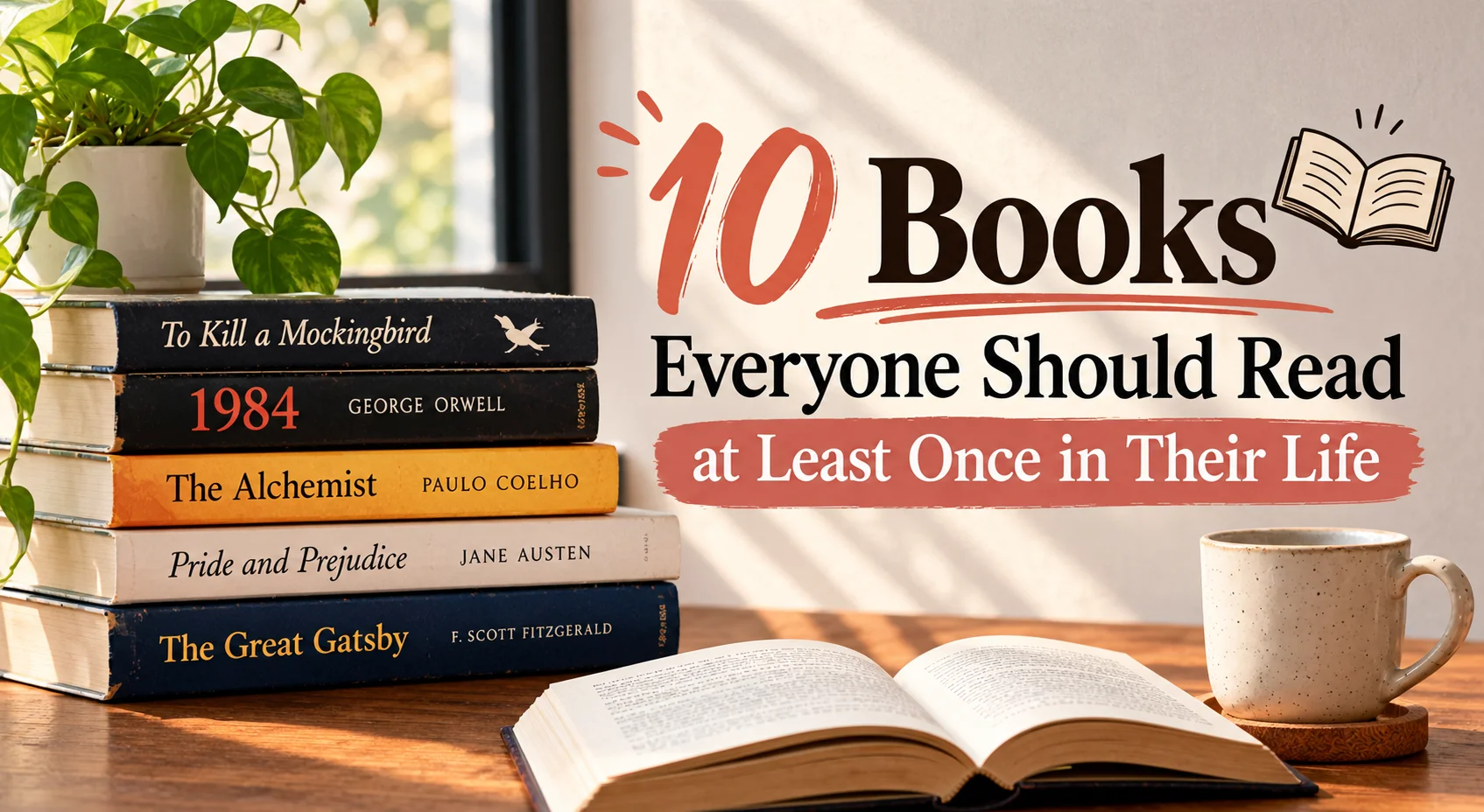

10 Books Everyone Should Read at Least Once in Their Life
8 min reading
Discover 10 must-read books that have inspired, challenged, and entertained readers for generations. From timeless classics to powerful modern stories, explore books worth reading at least once in your life.
Books have a unique ability to change the way we see the world. A great book can entertain us, challenge our beliefs, introduce us to unfamiliar lives, or simply give us a few quiet hours away from everyday distractions. With millions of books available today, choosing what to read can feel overwhelming. You don't need to read every bestseller or follow every popular reading list. Sometimes, the best place to start is with books that have remained meaningful to readers across generations.
From timeless classics to powerful modern stories, here are 10 books everyone should read at least once in their life.
1. To Kill a Mockingbird by Harper Lee
To Kill a Mockingbird is one of the most widely read novels in modern literature. Set in the American South during the 1930s, the story follows Scout Finch as she begins to understand prejudice, injustice, compassion, and the complicated nature of adulthood. One of the novel's greatest strengths is its perspective. Scout is young, but through her eyes readers witness serious questions about morality and society.
Why you should read it
The book encourages readers to think about empathy and fairness. It is particularly powerful because it shows how children can sometimes see injustice more clearly than adults.
Best for: Readers interested in classic literature, social issues, coming-of-age stories, and historical fiction.
2. 1984 by George Orwell
What happens when a government attempts to control not only people's actions but also their thoughts?
George Orwell's 1984 explores surveillance, propaganda, political control, censorship, and the manipulation of truth. Published in 1949, the novel imagines a frightening future dominated by an authoritarian government. Despite being decades old, its themes continue to make readers think about privacy, information, language, and political power.
Why you should read it
1984 is more than a dystopian story. It asks an important question: What happens to freedom when someone else controls the truth?
Best for: Readers who enjoy dystopian fiction, political novels, psychological stories, and thought-provoking literature.
3. The Alchemist by Paulo Coelho
The Alchemist follows Santiago, a young shepherd who dreams of finding a treasure. His journey takes him far from home and introduces him to people and experiences that change his understanding of life.The novel is simple in style but philosophical in its ideas. It explores dreams, purpose, courage, destiny, and the importance of listening to yourself.
Why you should read it
The book is especially appealing to readers who feel uncertain about their direction in life. Its central message encourages people to pursue meaningful goals instead of allowing fear to make decisions for them.
Best for: Young adults, new readers, and anyone looking for an inspirational story.
4. Pride and Prejudice by Jane Austen
First published in 1813, Pride and Prejudice remains one of the most beloved romance novels in English literature.
At its center are Elizabeth Bennet and Mr. Darcy, two intelligent characters whose first impressions of each other are far from favorable. As the story develops, both are forced to reconsider their assumptions. But the novel is not simply a love story. Jane Austen also examines social class, marriage, family expectations, reputation, and human behavior.
Why you should read it
Austen's wit makes the novel surprisingly entertaining even for modern readers. The characters are memorable, and the story demonstrates how quickly people can misunderstand one another.
Best for: Romance lovers, classic-fiction readers, and anyone who enjoys clever dialogue.
5. The Great Gatsby by F. Scott Fitzgerald
Set during the glamorous Jazz Age, The Great Gatsby tells the story of Jay Gatsby, a mysterious millionaire whose life revolves around his dream of reconnecting with Daisy Buchanan. Behind the parties, wealth, and luxury is a much darker story about ambition, obsession, class, and the pursuit of an idealized past.
Why you should read it
The novel is short but surprisingly rich. Each time you revisit it, you may notice something different about its characters and themes.
It also raises an enduring question: Can achieving everything you want actually make you happy?
Best for: Readers who enjoy classics, literary fiction, romance, and stories about ambition.
6. The Little Prince by Antoine de Saint-Exupéry
Don't let its short length fool you. The Little Prince is a deceptively simple book that explores friendship, love, loneliness, responsibility, and the difference between childhood and adulthood.The story follows a young prince who travels between planets and meets unusual characters along the way.
Why you should read it
It is one of those rare books that can mean something different at different stages of your life. A younger reader may see it as a charming story, while an adult may recognize deeper ideas about relationships and human nature.
Best for: Readers of all ages, especially those who enjoy philosophical and emotional stories.
7. The Kite Runner by Khaled Hosseini
The Kite Runner is a deeply emotional novel about friendship, family, guilt, betrayal, and redemption.
The story follows Amir, who grows up in Afghanistan and later moves to the United States. Years after a traumatic childhood event, he is forced to confront his past.The novel also introduces readers to Afghanistan through the experiences of its characters, giving the personal story a broader historical and cultural context.
Why you should read it
It is an emotionally powerful reminder that our past can shape us—but it doesn't necessarily have to define our future.
Best for: Readers who enjoy emotional literary fiction, family stories, historical settings, and character-driven novels.
8. Man's Search for Meaning by Viktor E. Frankl
Viktor Frankl's Man's Search for Meaning is part memoir and part psychological reflection. Frankl describes his experiences as a prisoner in Nazi concentration camps and explores how people respond to extreme suffering.The book introduces ideas from Frankl's psychological approach, often associated with the search for meaning as a fundamental human motivation.
Why you should read it
This isn't an easy book, but it is an important one. It encourages readers to consider how purpose, attitude, and meaning can influence the way we face difficult circumstances.
Best for: Readers interested in psychology, philosophy, personal growth, and memoirs.
9. The Book Thief by Markus Zusak
Set in Nazi Germany, The Book Thief tells the story of Liesel Meminger, a young girl who discovers the power of words and books during one of history's darkest periods.The novel combines historical fiction with friendship, family, loss, courage, and the extraordinary power of storytelling. One of its most distinctive features is its narrator, which gives the novel an unusual perspective.
Why you should read it
The book demonstrates how stories can provide comfort and connection even during times of tremendous hardship.
Best for: Readers who love historical fiction, emotional stories, and books about books.
10. Atomic Habits by James Clear
Not every important book has to be a novel. Atomic Habits takes a practical approach to understanding how small behavioral changes can lead to significant results over time.James Clear focuses on the systems behind habits and offers strategies for building good habits while making unwanted behaviors more difficult.
Why you should read it
Its biggest appeal is its practicality. Rather than relying only on motivation, the book encourages readers to think about their environment, routines, and systems.
Best for: Students, professionals, entrepreneurs, and anyone interested in personal development.
Why Reading These Books Matters
There is no universal list of books that everyone must read. Reading is personal, and the books that matter most to you may be completely different from someone else's favorites.
However, the books on this list cover a wide range of human experiences:
- Love and relationships
- Friendship and family
- Ambition and failure
- Freedom and political power
- Personal growth
- Identity and morality
- Grief and redemption
- Purpose and meaning
Reading across different genres can also make you a more flexible reader. A classic novel can introduce you to another period in history, while a psychological book can challenge the way you think about yourself.
How to Choose Which Book to Read First
If you're new to reading, you don't need to start with the longest or most difficult book.
Choose based on what interests you right now.
If you want romance, try Pride and Prejudice.
If you want inspiration, The Alchemist may be a good starting point.
If you enjoy dystopian fiction, choose 1984.
If you're interested in personal development, try Atomic Habits.
If you want an emotional story, The Kite Runner or The Book Thief could be worth exploring.
And if you're looking for something short but meaningful, The Little Prince is an excellent choice.
Final Thoughts
The best books don't simply give us information. They change the questions we ask.
Some books entertain us for a few hours. Others stay in our minds for years. The books on this list have earned their place because they offer stories and ideas that continue to connect with readers across different generations.
You don't have to read all ten at once. Pick the one that speaks to you, find a comfortable place, and begin.
Because sometimes, one good book is enough to change the way you see the world.